


The Ins And Outs Of Giving A Gift Of Money (2026 Gift Tax Rules)

While exchanging presents at the holidays or gift cards on birthdays is always special, sometimes people have the ability to give more in the form of a monetary gift. Not a $20 bill tucked in a birthday card, but the bigger sums the IRS categorizes as a “financial gift.” These gifts can be incredible, even life-changing.
Perhaps a friend or family member has a windfall that they want to share, or maybe a grandparent wants to help a grandchild purchase a first home. If you’re in a position to either give or receive a financial gift, lucky you! But you’ll need to make certain you know the rules before you write a check or have money transferred. Here’s a breakdown of how the gift tax works in 2026.
2026 Gift Tax Rules at a Glance
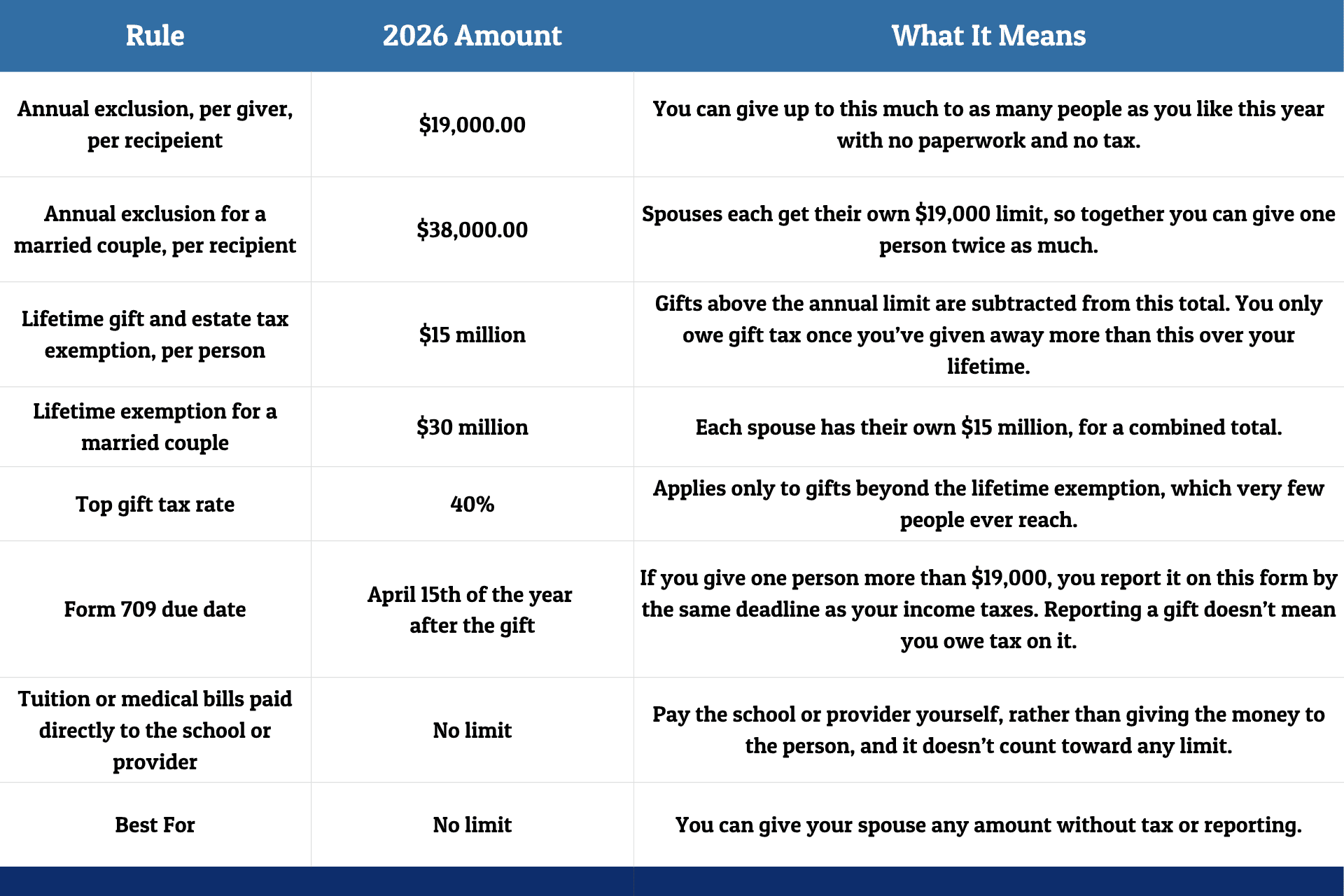
Figures from the IRS and its 2026 inflation adjustments. The IRS typically announces next year’s figures in the fall; we’ll update this table when 2027 amounts are released.
What Is A Monetary Gift?
According to the IRS, a gift is “any transfer to an individual, either directly or indirectly, where full consideration (measured in money or money’s worth) is not received in return.” It’s a monetary gift that is given freely, it isn’t payment for something else, and it’s money that never has to be paid back.
But there are limits on how much you can give without involving Uncle Sam. As much as we might wish you and your BFF could slip each other millions (like George Clooney did that one time) without ever having to say a thing, there are taxes to consider.
How Much Money Can You Gift Tax-Free in 2026?
For starters, anyone who receives a cash gift doesn’t have to worry about taxes. Taxes are paid by the giver. In 2026, any single person can give another single person up to $19,000 during the year without tax implications. This figure is known as the gift tax “exclusion” amount, and it can change from year to year based on inflation.
But keep in mind that $19,000 is the maximum a single person can give without tax implications. Married couples can combine their resources to give much more. If you are married, you can give up to $38,000 to an individual. This is because one half of the couple can give $19,000 to a person, and the other half of the couple can give $19,000 to the same person.
For example, say a mom and dad want to give a generous financial gift to their daughter, son-in-law, and granddaughter.
- The maximum amount they could give that family without tax implications would go up to $114,000.
- That’s because the mom could give $19,000 three times: once to her daughter, once to her son-in-law, and once to her granddaughter ($57,000).
- The dad could also give $19,000 three times to his daughter, son-in-law, and granddaughter ($57,000), for a total of $114,000.
One detail to know: this works most simply when each spouse gives from their own money. If the whole gift comes from one spouse’s account, the couple can choose to “split” it so it counts as coming from both of them. That choice is made on IRS Form 709, so a return is required even though no tax is owed.
What Is the Lifetime Gift Tax Exemption?
In addition to being able to gift $19,000 per person each year, each individual has what’s called a “lifetime gift exemption.” This is the amount the government allows you to give away during your life or as part of your estate at death before gift and estate taxes kick in.
In 2026, this amount stands at $15 million per person, or $30 million for a married couple. Any gifts above the annual exclusion simply reduce your remaining lifetime exemption. Go over that full amount and, yes, the giver will owe taxes ranging from 18% to 40%.
When Do You Need to File IRS Form 709?
What if you want or need to give a gift that’s over the annual exclusion? Unless we’re talking millions and millions, there aren’t going to be taxes owed, but you do have to file an additional form with your taxes: IRS Form 709. On this form, you’ll disclose exactly how much you gave, per recipient.
Form 709 is the giver’s responsibility. The person receiving the gift doesn’t file it. You’ll generally need to file if you:
- Gave more than $19,000 to any one person (other than your spouse) during the year
- Want to split a gift with your spouse, as described above
- Gave an asset, like a car, property, or stocks, worth more than $19,000
Form 709 is due April 15 of the year after the gift, the same day as your income tax return. If you get an extension on your income tax return, it extends your Form 709 too.
Gifts that are Never Taxed
Some monetary gifts are never taxed, no matter the amount given:
- Gifts to Your Spouse: If your spouse is a U.S. citizen, you can give them any amount. At death, one spouse can pass an estate of any size to the other.
- Gifts to a Qualifying Charity or a Political Organization: If charitable giving is part of your plan, batching your charitable donations can lower your taxes.
- Tuition and Medical Bills: If you’d like to help someone out with tuition or medical bills, those gifts are never taxed as long as you pay the school or medical provider directly, rather than writing a check to the recipient. For school costs, this covers tuition only, not books, supplies, or room and board.
Lastly, if you’re planning to give an asset like a car or a property, know that it’s also taxable as a gift, and the $19,000 exclusion still applies. Per the IRS, “The general rule is that any gift is a taxable gift,” and the gift will be valued at “fair market value.” This means you can’t gift your child a 40-acre property and value it as $1, or gift a friend a Ferrari and value it as if it’s a Honda Civic.
If the asset produces income, like an apartment building or a stock portfolio, the giver reports the gift on Form 709 when it’s worth more than the annual exclusion. The recipient doesn’t file Form 709, but they will owe income tax on what the asset earns once it’s theirs, such as rent or dividends. They also generally take on the giver’s original cost basis, which matters if they sell it later. Your tax preparer can tell you more, based on your unique situation.
How to Gift Money to Someone
Once you know how much you’d like to give, choose the method that fits the gift and the person receiving it:
- Check or Account Transfer:
- Good For: Most cash gifts to adults
- Keep in Mind: Note “gift” in the memo and keep a record, especially for gifts over $19,000
- A Savings Account or Certificate for a Child or Grandchild:
- Good For: Gifts meant to grow over time
- Keep in Mind: Accounts for minors are typically opened with an adult; open an account or ask a branch which option fits
- Paying the School or Provider Directly
- Good For: Tuition and medical bills
- Keep in Mind: Payments go straight to the institution and don’t count toward the $19,000 limit
- Investments:
- Good For: Long-term goals like education or retirement
Keep in Mind: Talk with Sound’s investment services team about options and tax treatment
- Good For: Long-term goals like education or retirement
Whatever method you use, be clear in writing that the money is a gift and not a loan. It protects the relationship and makes things simpler if a lender or tax preparer ever asks.
Gifting Money for a Down Payment
Helping a child or grandchild buy their first home is one of the most common reasons people give a large financial gift. If the money is going toward a down payment, the lender will usually ask for a gift letter: a signed statement from the giver confirming the amount, their relationship to the buyer, and that the money doesn’t have to be paid back. Lenders may also ask to see records showing the money moving from the giver’s account to the buyer’s.
The same gift tax rules apply. Two parents can give $38,000 in 2026 without filing a return, and a larger gift just means filing Form 709. If you’re planning to help with a down payment, talk with your home loan officer early so the gift is documented the way the lender needs it.
Rules for the Giver and the Recipient
If You’re The Giver:
- The first and most important: make sure you have the resources to give the gift. The last thing you want to do is let your generous heart overextend your budget. Review your financial situation with a trusted financial advisor before you give, especially if the gift affects your retirement planning.
- Importantly for parents and grandparents: If you start making annual gifts, be very clear with your offspring about whether this is a one-time thing or something that will continue. You don’t want to set expectations that come back later to damage your relationships.
- As the gift-giver, it’s your responsibility to report gifts above the annual limit on Form 709. This is true whether you’re giving cash, assets, or income-producing assets.
If You’re The Recipient:
- With a monetary gift, you don’t have to do anything but send a thank-you note. Make sure, however, that the gift is a true gift and not a loan. The last thing you want is to have stress or friction with friends and family over a lack of understanding around money.
- If you receive an income-producing asset, like a rental property, you won’t file Form 709, but you will report and pay income tax on the income it earns from then on.
- If the money is helping you buy a home, ask your lender early what gift documentation they need.
- If you plan to use the money you’ve been given for tuition or medical expenses, make sure to keep your receipts. Your tax preparer can advise you if there may be tax deductions available.
The Bottom Line on Giving a Gift of Money
For most people, giving a generous gift of money is far simpler than it sounds. In 2026, you can give up to $19,000 to as many people as you’d like with no tax and no paperwork. Go above that, and you’ll likely just file Form 709 while your $15 million lifetime exemption does the rest. The bigger questions are usually personal ones: making sure the gift fits your own budget, being clear that it’s a gift and not a loan, and choosing the right way to give it.
Whether you’re helping a grandchild with a first home, setting aside savings for a new baby, or sharing a windfall with someone you love, Sound is here to help. Stop by a branch or contact us to talk through the best way to give, and consult a tax professional for advice on your specific situation.
Disclosures
You may also like…

Business Beacon: Olympia Master Builders
Olympia Master Builders invest in building strong communities, one home at a time.

Credit Card Refinancing: What It Is and When It Makes Sense
Learn How Credit Card Refinancing Works, How to Choose Between a Balance Transfer and Personal Loan, and How to Refinance Without Hurting Your Credit.

Business Beacon: Thurston Chamber Education Foundation
Thurston Chamber Education Foundation helps people of all ages find their purpose and reach their potential.